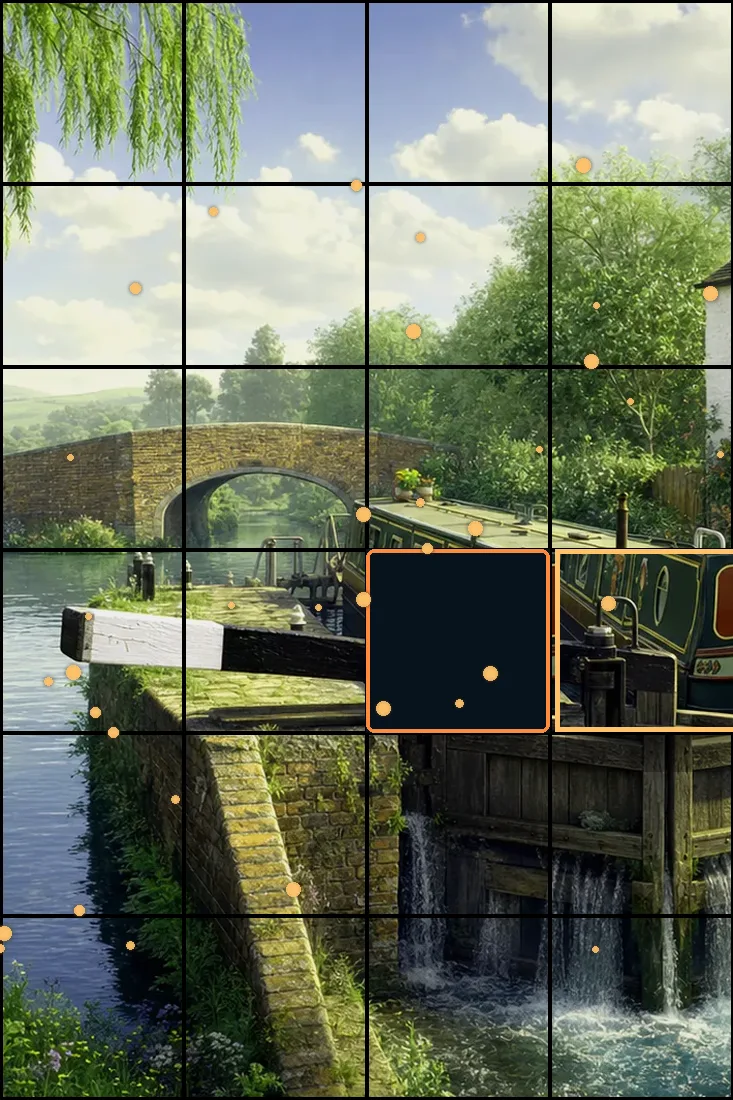
A lock keeper spends the day moving water from one chamber to the next until everything is level. Lockkeeper’s Tiles asks something similar of you: move one tile at a time into the single empty space until a scattered picture is whole again. There are eight scenes to choose from, including the long pound, the painted cabin doors, the keeper’s lock and the watercress beds.
Each picture can be played as a 3x3, 4x4 or 5x5 grid. A move counter and a timer start with your first slide, and the game remembers your best moves and time for every picture at every size. Every shuffle is generated so it can always be solved, however tangled it looks, and stars are awarded on the number of moves you needed, so a thoughtful approach beats frantic tapping.
How to play Lockkeeper’s Tiles
- Choose one of the eight pictures, then pick a 3x3, 4x4 or 5x5 grid from the menu.
- Press Play and watch the tiles fly from the finished picture to their shuffled places.
- Tap a tile next to the gap, swipe it, or use the arrow keys to slide it across.
- Hold Peek to see the whole picture, or switch on Numbers if you prefer counting to looking.
- Finish the picture to see your moves and time, and earn up to three stars for an efficient solve.
Lockkeeper’s Tiles controls
Getting better at Lockkeeper’s Tiles
- Solve the top row first, then the left column, and you are left with a smaller puzzle each time.
- Place the last two tiles of a row together, by parking one below its spot and sliding both in.
- Switch on Numbers for a 5x5 if the picture has large areas of sky or water that look alike.
- Peek costs nothing, so hold it whenever you lose track of where a corner should go.
- Learn a picture on 3x3 first, then move up a size once you know where its landmarks sit.
Eight scenes from the canal and beyond
Half the pictures belong to the canal itself: the long pound stretching away from the cabin, the rose-painted rear doors with their castle panel, the brick lock with its whitewashed cottage, and the willow arch where a butty boat drifts beneath the bridge. The others wander a little further: punts below university spires, a golden hedge maze, a fete on the village green and the watercress beds by a chalk stream.
Each picture has strong landmarks such as a bright door, a curve of bridge or a line of bunting, which makes them good to solve. You start by placing the striking pieces, and the quieter stretches of water or sky follow. Together they paint a gentle portrait of a summer journey through the English countryside.
Counting moves the way a keeper counts water
Stars depend on moves, not speed. The game works out roughly how far the shuffle sits from solved, and a finish close to that earns three stars, while a longer route still earns one or two. Every completed picture earns at least one star, so nobody leaves empty-handed.
That makes the timer a personal record rather than a pressure. You can stop and think as long as you like, plan three slides ahead, or simply enjoy watching the scene return. Best moves and best time are stored separately for each picture and size, so there are twenty-four little records waiting to be beaten.
Questions about Lockkeeper’s Tiles
Yes. Every shuffle is created by moving tiles from the finished picture using legal slides, so a solution always exists however mixed up it looks.
Stars are based on the number of moves you used. Fewer moves earn more stars, and every completed picture earns at least one.
No. Holding Peek simply shows the finished picture over the board. Your moves and time carry on exactly as before, so peek as often as you like while you work out where a stubborn corner tile belongs.